What Are Gravitational Waves? Listening to the Universe's Echoes
Imagine dropping a stone into a perfectly still pond. The ripples that spread out are like gravitational waves, but instead of water, they are ripples in the very fabric of space and time, created by the most violent events in the universe. First predicted by Albert Einstein's theory of general relativity in 1916 and first detected a century later in 2015, gravitational waves have opened up a completely new way to observe the cosmos.
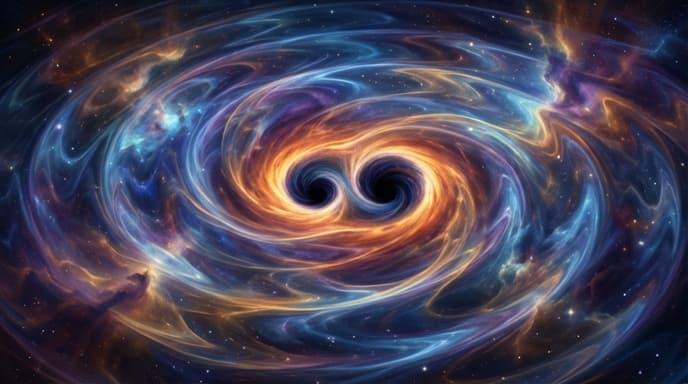
Einstein's Pond: The Fabric of Spacetime
To understand gravitational waves, you first need to understand 'spacetime.' Einstein imagined that space and time are not separate but are woven together into a single, four-dimensional fabric. Massive objects like stars and planets create dips or curves in this fabric—this curvature is what we experience as gravity. A rolling marble on a stretched sheet will curve around a heavy bowling ball placed in the center; in the same way, the Earth orbits the Sun because it's following the curve in spacetime created by the Sun's mass.
What Kind of Events Create These Waves?
Just as you need to drop a big stone to make big ripples, you need a cataclysmic cosmic event to generate gravitational waves strong enough for us to detect. The most powerful sources are:
- Colliding Black Holes: When two black holes spiral into each other and merge, they violently churn spacetime, sending powerful gravitational waves across the universe.
- Merging Neutron Stars: The collision of two of these incredibly dense stellar remnants also creates a strong gravitational signal.
- Supernovae: The explosive death of a massive star can, if the explosion is asymmetrical, produce gravitational waves.
How Do We Detect a Ripple in Spacetime?
Detecting gravitational waves is an incredible feat of engineering. The effect is minuscule: by the time a wave from a distant galaxy reaches Earth, it stretches and squeezes spacetime by an amount smaller than the width of an atomic nucleus. The Laser Interferometer Gravitational-Wave Observatory (LIGO) is designed to detect this tiny distortion. It consists of two identical, multi-kilometer-long vacuum tunnels arranged in an 'L' shape. A laser beam is split and sent down each arm. If a gravitational wave passes through, it will minutely stretch one arm and compress the other, knocking the laser beams slightly out of sync. This tiny change is the signal that scientists are looking for.
Frequently Asked Questions (FAQ)
Do gravitational waves travel at the speed of light?
Yes. Just like light, gravitational waves travel through the universe at the speed of light.
Can we 'hear' gravitational waves?
Not directly with our ears. However, scientists convert the detected wave frequencies into sound waves. The first detection from a black hole merger was famously converted into a 'chirp' sound that gets higher in pitch as the black holes spiral faster and faster together.
Why is this discovery so important?
For centuries, all of our astronomy was based on observing light (electromagnetic radiation). Gravitational waves are a completely new sense, allowing us to study phenomena that don't emit light, like black holes, and to peer into the heart of cosmic explosions. It's like gaining the sense of hearing after only being able to see.
Key Takeaways
- Gravitational waves are ripples in the fabric of spacetime.
- They are created by massive, accelerating objects like colliding black holes.
- They were predicted by Einstein's theory of general relativity over 100 years ago.
- Observatories like LIGO use lasers to detect the incredibly small distortions they cause.
- This technology gives astronomers a new way to 'listen' to the universe.
Suggested Internal Links
- What Are Rogue Planets? The Lonely Wanderers of Our Galaxy
- The Fermi Paradox: If Aliens Exist, Where Is Everybody?
- What Are Lagrange Points? The Universe’s Surprising Gravitational Parking Spots
Sources for Verification
- NASA educational materials on general relativity and gravitational waves.
- Official websites and publications from the LIGO Scientific Collaboration.